

Crafting machines to reproduce music is a profound responsibility, one that demands the utmost care. To alter the recorded art—even in the name of personal taste or added flair—is to abandon the very essence of high fidelity.


Most people today live surrounded by noise, with fewer and fewer opportunities to experience live music. Many have grown accustomed to low-quality sources and compressed formats, gradually developing a preference for exaggerated, “circus-like” reproduction: bloated bass, piercing highs, artificial soundstaging, and unnatural, uninvolving midranges.

For those who measure reproduced sound against the living, breathing reality of a live performance, true fidelity is absolutely achievable. Comparing one system to another is a common trap—one that ultimately leads listeners away from both high fidelity and genuine musical enjoyment.

No, not at all.
Instead, sit before a natural-sounding system, anchor your reference in the memory of the last live concert you attended, and trust your instincts. They will not lead you astray.
While high efficiency is the horn’s most celebrated virtue—and rightly so, as it offers the highest conversion ratio of electromechanical energy to sound pressure—we believe its other qualities are far more significant.

Consider this: a driver’s diaphragm or cone (whether paper, metal, or ceramic) is far denser than the air it must move. For an 8-inch driver, the load it “sees” is the entire volume of air in the listening room—a formidable task. In a horn, however, the driver works against a confined air mass at the throat, where high pressure builds and increases air density. This gives the driver a more solid, resistant load to push against. That pressurized air then expands progressively down the horn’s length to the mouth. This is the optimal loading condition for a driver.
Because of this superior coupling between cone and air, the driver needs only minimal movement to produce the same output as conventional designs—dramatically reducing distortion. However, the high pressure at the throat demands a diaphragm that remains rigid and undeformed, paired with a powerful motor assembly (strong magnet, narrow voice-coil gap). Selecting the right driver is critical, and success often lies in uncovering hidden gems among the mediocre.
Furthermore, a horn’s controlled directivity minimizes early reflections from side walls, floor, and ceiling—far more than any other speaker arrangement. This makes horns remarkably room-friendly and less finicky about placement. The trade-off is a defined sweet spot, where imaging and energy delivery reach their peak.
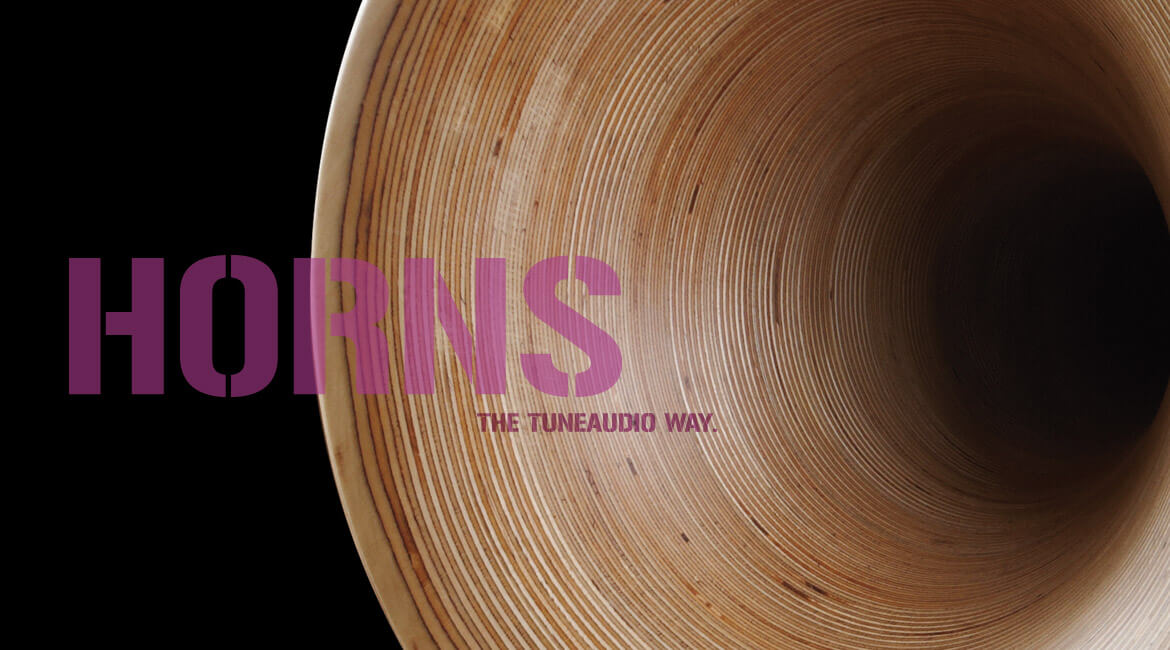
Our mid and high-frequency designs employ Tractrix horns, chosen for their exceptionally low distortion compared to other contours. We are equally committed to horn loading for the bass—sacrificing the transient response of a bass horn for the sake of compact size is not an option. Our proprietary virtual-mouth and mass-loading technology delivers the full benefits of a true bass horn in a fraction of the usual footprint.
The result is bass that is as fast as it gets, releasing energy into the room in a way that makes booming a forgotten memory. We tune every horn according to the principle of “as simple as possible”—meaning no corrective additions to mask design flaws. Our designs are perfected from the ground up, so we never resort to correction networks or excessive damping.

Building high-fidelity horns is far more demanding than most conventional loudspeaker designs. The material itself is an active participant in energy transfer, as critical as the drivers. We select materials for each specific application: our low- and mid-frequency horns are constructed from Grade A Baltic birch plywood. Its high thickness ensures the stiffness and minimal energy storage needed for a silent horn that maximizes transfer efficiency. Grade A guarantees a void-free, uniform density for consistent, repeatable performance.
For high frequencies, we developed a proprietary mixture of epoxy resin and specialized aggregates. This unique compound achieves near-perfect energy transfer with virtually zero loss and distortion.

Our design process is driver-agnostic: we conceive the horn first, then select the ideal driver for each specific task—never the reverse. This is precisely why we do not limit ourselves to a single manufacturer. Instead, we source drivers from respected European and Japanese brands and modify them in-house to ensure flawless integration with our original designs.
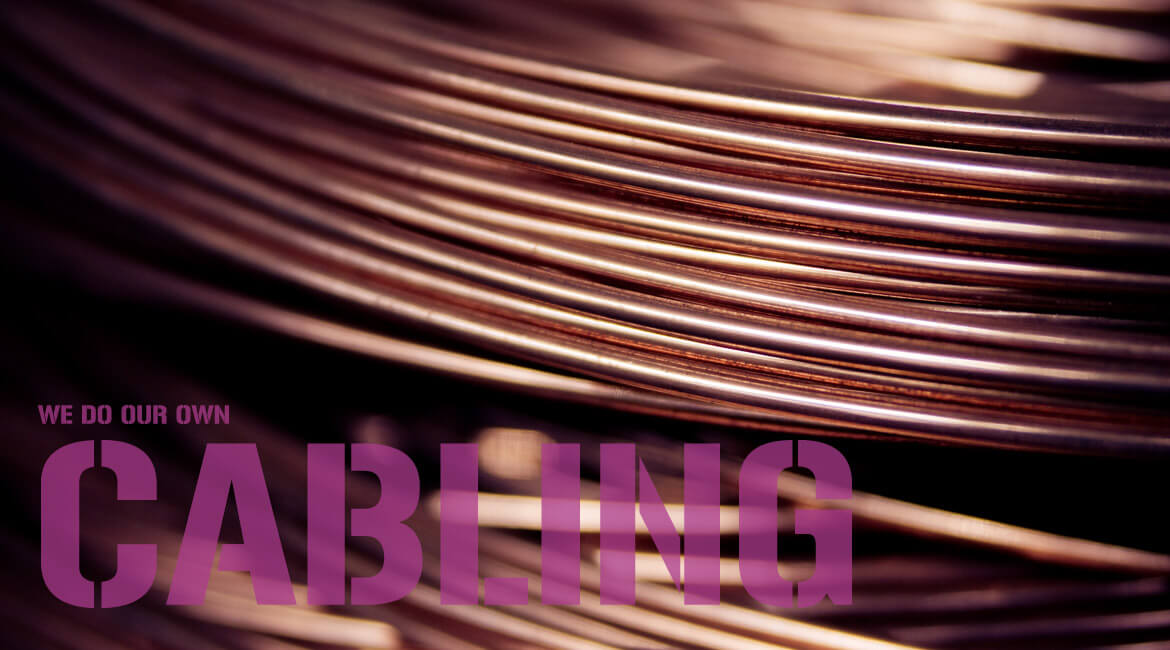
For cabling, we use high-purity Italian OFC copper, believing that adequately thick copper leaves the smallest sonic footprint of any conductor. Our insulation follows old-fashioned methods: the copper is wrapped in cotton fabric, soaked in beeswax, polished, twisted, and terminated with solid brass connectors.

We employ only first-order crossovers, hardwired onto Bakelite boards with secured brass screws. These crossovers are positioned as far as possible from the drivers and their magnetic fields, and the components are generously spaced to minimize any interference.
Our time alignment is achieved through physical design—not electronic correction networks. We refuse to add more components to compensate for design shortcomings.
High efficiency unlocks explosive dynamics without the penalty of power compression, while also freeing your amplifier and cable choices. Our designs present an easy, amplifier-friendly load, eliminating the need for high-feedback designs. We prefer amplifiers with low stage counts, as they align perfectly with our “as simple as possible” ethos.
Every module is handcrafted using traditional building practices, and all critical components are produced in-house—no subcontractors. Our finishing options are entirely open-ended: we can paint our performers in any color you choose, and natural wood veneer finishes are available at an additional cost. As a result, every speaker is built to order, with delivery times varying by model.


© Copyright TuneAudio.